
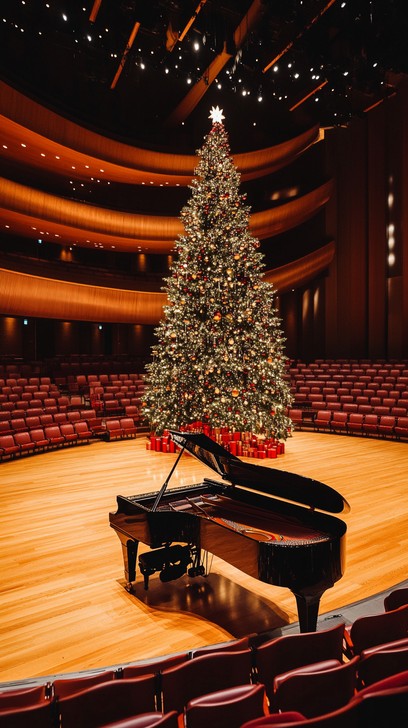
How Composers Translate the Season into Sound
Christmas has inspired composers across centuries to reflect spirituality, warmth, childhood wonder, and quiet introspection. While choral and orchestral works often dominate the season, the piano repertoire offers a deeply personal and intimate expression of Christmas — one shaped by touch, colour, and imagination.
Rather than telling a literal story, composers use the piano to suggest atmosphere: bells ringing in the distance, candlelight, snowfall, and moments of contemplation. Each composer approaches Christmas through their own aesthetic language, revealing how the same season can inspire vastly different musical worlds.
Johann Sebastian Bach: Sacred Foundation
Although Bach did not compose Christmas piano pieces as we know them today, his keyboard works are deeply rooted in Lutheran chorale tradition, which forms the spiritual backbone of Christmas music. Chorales such as Vom Himmel hochappear throughout his sacred output and influence the phrasing and structure of many keyboard works.
When pianists perform Bach during the Christmas season, the emphasis lies on:
- clarity of voicing
- vocal-style phrasing
- inner calm and balance
Christmas here is not theatrical, but devotional and architectural, grounded in faith and order.
Franz Liszt: Spiritual Reflection and Transcendence
Liszt approached Christmas with profound spirituality. Works such as selections from Weihnachtsbaum (Christmas Tree)present the season as both intimate and transcendent. Liszt combines simple carol-like melodies with rich harmonic colour, inviting deep listening rather than virtuosity.
In Liszt’s Christmas-inspired piano music:
- sound quality takes precedence over brilliance
- bell effects are subtle and atmospheric
- phrasing follows a vocal, almost prayer-like line
The pianist must go beyond mechanics and focus on inner resonance, a hallmark of the Liszt tradition.
Pyotr Ilyich Tchaikovsky: Childhood and Celebration
Tchaikovsky’s The Seasons, particularly December: Christmas, captures the festive and social side of the holiday. Dance rhythms, lyrical charm, and elegant simplicity reflect gatherings, warmth, and youthful joy.
Tchaikovsky’s Christmas writing relies on:
- clear rhythmic character
- singing melodic lines
- controlled brilliance without heaviness
Here, Christmas becomes nostalgic and human, seen through the eyes of memory.
Claude Debussy: Atmosphere and Light
Debussy approaches winter and Christmas through suggestion rather than depiction. While not explicitly religious, pieces like Des pas sur la neige or winter-themed preludes evoke silence, distance, and reflection — emotions closely tied to the season.
Debussy’s Christmas-like sound world is shaped by:
- modal harmony
- delicate pedalling
- blurred edges and soft resonance
The pianist paints light and shadow, allowing sound to float rather than project.
Béla Bartók: Folk Roots and Simplicity
Bartók’s For Children and Romanian folk-inspired pieces include arrangements of traditional songs associated with winter and Christmas. His approach is honest and direct, rooted in folk simplicity rather than romantic idealisation.
Bartók’s Christmas-related writing emphasises:
- rhythmic clarity
- earthy tone production
- natural phrasing inspired by speech
This music reminds us that Christmas is also a community experience, grounded in shared tradition.
Olivier Messiaen: Mysticism and Faith
Messiaen’s piano works, though rarely labelled as Christmas music, are deeply connected to Catholic spirituality and themes of divine light, eternity, and incarnation. Pieces from Vingt regards sur l’Enfant-Jésus represent one of the most profound musical reflections on Christmas.
Messiaen uses:
- extreme contrasts of colour
- complex rhythms
- symbolic harmony
Here, Christmas is cosmic and theological, requiring total emotional and spiritual commitment from the pianist.
Performance Considerations: Interpreting Christmas on the Piano
Across all styles, Christmas repertoire demands a special performance approach:
- refined tone production
- flexible, vocal phrasing
- emotional sincerity
- restraint over display
The pianist must listen more than play, shaping sound as speech and silence as meaning.
A Season That Invites Depth
Christmas piano music, whether sacred, folk-inspired, romantic, or modern, shares a common goal: connection. It invites performers and listeners alike to slow down, reflect, and listen deeply.
For pianists, these works offer a reminder that true artistry lies not in volume or speed, but in sound, phrasing, and intention — values that remain central to the great piano traditions passed down through generations.