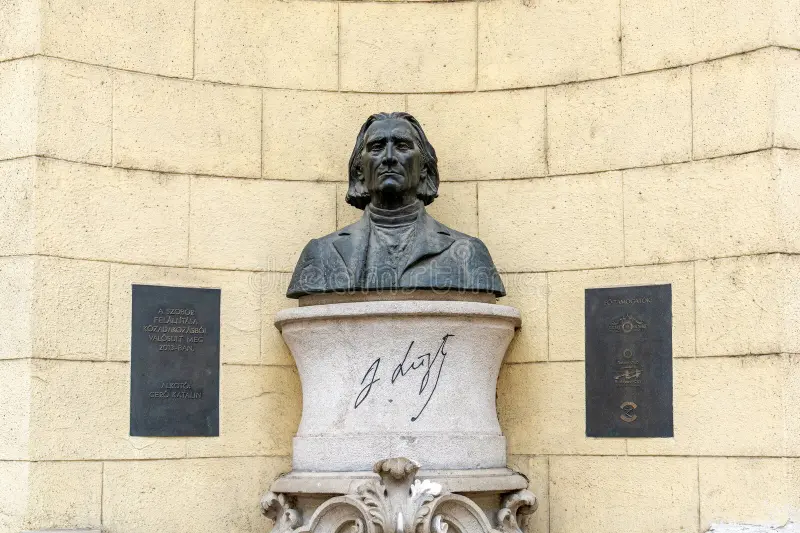
Sculpture of Franz Liszt: Masterpiece by Katalin Gerő
When speaking about piano technique, few names carry the same weight, influence, and mystique as Franz Liszt. His legacy is often associated with transcendental virtuosity, dazzling brilliance, and unprecedented technical demands. Yet, behind the legend lies a deeply structured pedagogical tradition, one that begins far earlier and far more simply than many pianists realise.
At PianoMasterClass.com, we believe that understanding Liszt’s technique means starting at its true foundation — with the Études Op. 1.
Liszt’s Vision of Technique: More Than Virtuosity
Liszt never considered technique as an end in itself. For him, technical mastery was inseparable from sound, phrasing, and expressive freedom. Technique existed to liberate musical imagination, not to display mechanical brilliance. This philosophy was inherited from his teacher Carl Czerny, and further enriched by Liszt’s own artistic and poetic nature.
What makes Liszt’s approach unique is its organic development. Every technical element is introduced in a way that prepares the hand, ear, and mind simultaneously. This is why beginning with the Études Op. 1 is not a step backward — it is a step toward depth.
Études Op. 1: The Hidden Cornerstone
Often overlooked or underestimated, Liszt’s Études Op. 1 are not concert pieces but technical and musical laboratories. Written at a young age, they already reveal Liszt’s awareness of how technique should evolve naturally through intelligent movement, controlled touch, and refined listening.
These études address essential elements such as:
- finger independence without tension
- early control of arm weight
- balance between fingers and wrist
- clarity of articulation
- coordination between hands
But above all, they cultivate a beautiful, singing sound from the very beginning.
This is a crucial point: Liszt’s technique does not start with power — it starts with quality.
Sound as the Core of Technique
One of the most misunderstood aspects of piano technique today is the idea that sound is something added after technical mastery. In the Liszt tradition, the opposite is true. Sound is the starting point.
Even in the simplest exercises of Op. 1, Liszt encourages the pianist to:
- listen deeply to each note
- shape phrases naturally
- feel the resistance and response of the key
- connect physical movement to musical intention
This approach builds a refined touch, long before virtuosity enters the picture. Without this foundation, later repertoire — including the Transcendental Études — becomes physically dangerous and musically shallow.
From Simplicity to Freedom
Liszt’s genius lies in his ability to transform simplicity into freedom. The Études Op. 1 are not meant to impress; they are meant to educate the body and the ear.
Through them, the pianist learns:
- how to release unnecessary tension
- how to use gravity instead of force
- how to let the arm support the fingers
- how to produce resonance rather than volume
This gradual development prepares the pianist for more complex textures, wider spans, and denser harmonies — without sacrificing ease or sound quality.
The Continuation of a Living Tradition
Liszt’s technical principles were passed down through generations of pianists and teachers, forming what we now call the Liszt Piano School. This tradition emphasises:
- natural movement
- expressive phrasing
- tonal imagination
- physical efficiency
At PianoMasterClass.com, we consider this lineage not as historical material, but as living knowledge — knowledge that must be understood, felt, and applied in modern performance.
Why Modern Pianists Need This Approach
In today’s fast-paced musical world, pianists are often pushed toward results before foundations are solid. Speed, volume, and difficulty dominate, while sound quality and phrasing are neglected.
Returning to Liszt’s method — beginning with Études Op. 1 — offers a powerful correction. It reconnects pianists with:
- conscious listening
- expressive intention
- physical awareness
- artistic responsibility
Technique becomes once again a tool for communication, not competition.
Liszt at PianoMasterClass.com
In our exclusive video course at PianoMasterClass.com, we explore the Liszt tradition step by step — beginning precisely where it should begin. Through detailed demonstrations, explanations, and musical examples, we reveal:
- how Liszt’s technique works in practice
- how to apply it to repertoire
- how to transform exercises into music
- how to develop a personal, beautiful sound
This knowledge is rarely taught today, yet it remains essential for any pianist seeking depth, longevity, and artistic truth.
Conclusion: Returning to the Source
To understand Liszt is not to chase virtuosity, but to return to clarity, sound, and expression. The Études Op. 1 remind us that greatness begins quietly — with awareness, patience, and respect for the instrument.
By starting here, pianists do not limit themselves. They prepare themselves for everything that follows.
István. I. Székely